
Safety coach
A feature in Volvo Cars app that helps you drive safer and pay less for insurance
Volvo’s heritage is safety. In the digital era, that means helping people understand and improve how they drive, before anything goes wrong.
I led this multi-platform product (mobile & car) end to end: early desirability research, partner evaluation, implementation, and the roadmap beyond it.
24%
Take rate, more than double the ~10% industry benchmark
Weekly habit
People come back roughly 4.3 days out of every 28, ahead of most other features in the Volvo Cars app.
12 %
retention by month 3 in the Italy pilot. This is what we are actively improving.
Getting people in
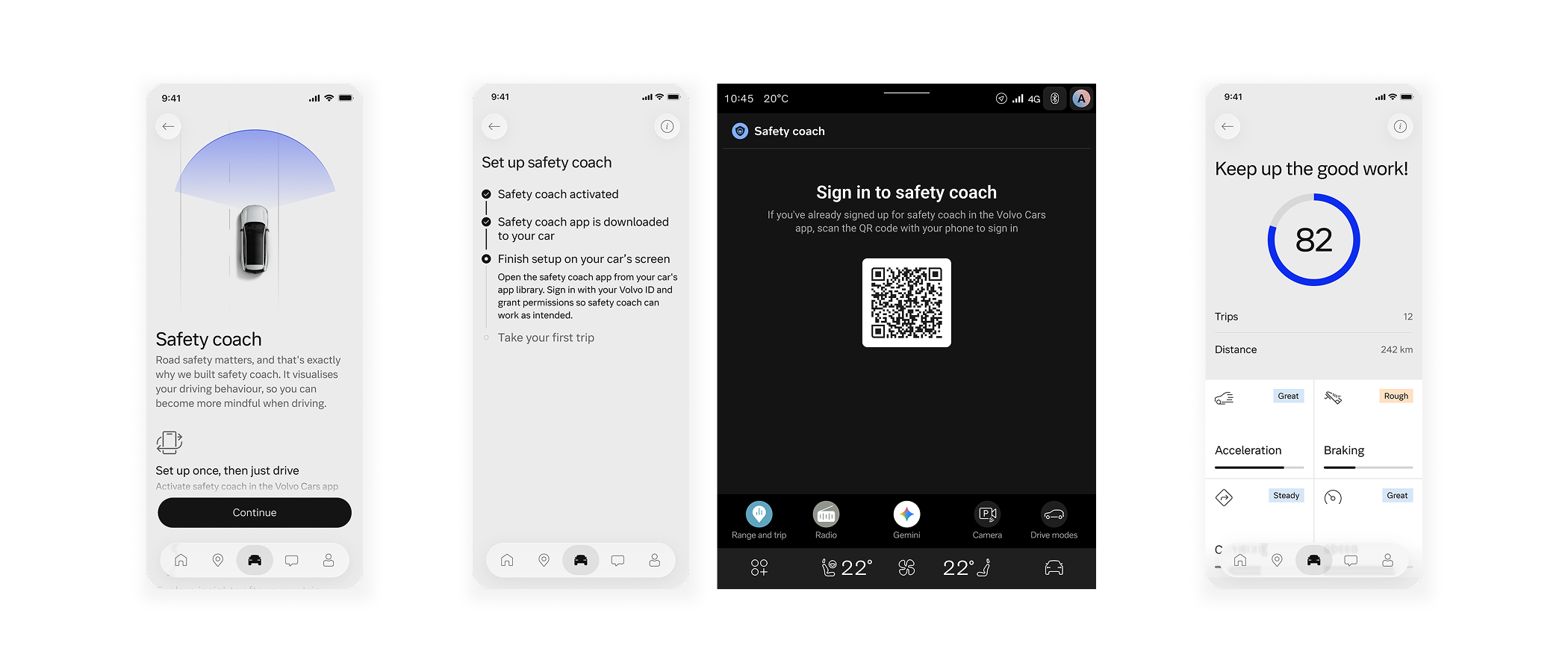
The experience leads with two things: a low hurdle to join, and clear data privacy. Data is never shared with insurance. Consent is upfront, not buried.
For customers who want more, a learn-more section covers score mechanics and edge cases, like per-driver vs. per-car tracking.
*Grounded in user research
Making onboarding painless
Setup continues in the car. The car interface exists to get the pipeline running, nothing more.
Insight lives in the Volvo Cars app, often right after a trip. I directed the in-car screens with our telematics partner CMT to hold that line, keeping score states aligned with mobile.
*Shaped by technical constraints
Bringing people back
The first feature shipped beyond the score itself addressed one pain point directly: people didn't understand how to improve, and didn't trust how the score was calculated.
The fix: one score broken into four areas of actionable behavior, each with a tier, Great, Steady, Rough, and a progress bar for granularity.
*Not the finished vision, but a base to learn from. Already in testing for the next iteration, alongside other features to enrich the experience.
What’s next
Two features are next in line: trip history, which answers "the score feels random," and driver comparison, which answers "I don't know what good looks like." I've also directed early gamification research with two thesis researchers, pressure-testing what's worth building before it reaches implementation.